


Page 6 - All Scale Rails Magazine Issue 27_ 2021
P. 6
www.AllScaleRails.com

            Captain Andrew Hickenlooper, Sher-
        man’s Chief Engineer was more specific
        when he said, “destroying the
        railroad…was effected by taking up the
        rails and piling the ties together 5 or 6
        feet high and 4 feet wide, balancing the
        rails on their sides with weights on each
        end, and setting fire to the piles. The
        rails would invariably bend 30-40 de-
        grees.”
             The instructions were clear: the rails
        were to be pried form the ties, which
        were then stacked and lit on fire.  Once
        the rails that had been stretched over the
        fire turned red hot and had softened, the
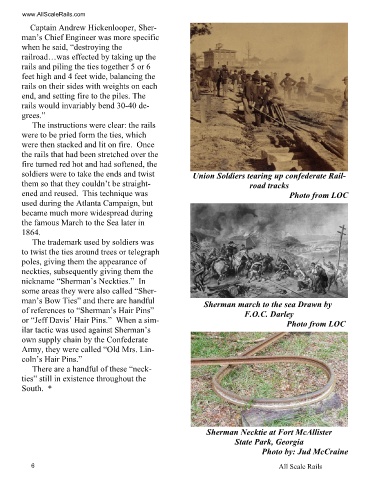
        soldiers were to take the ends and twist                 Union Soldiers tearing up confederate Rail-
        them so that they couldn’t be straight-                                     road tracks
        ened and reused.  This technique was                                                     Photo from LOC
        used during the Atlanta Campaign, but
        became much more widespread during
        the famous March to the Sea later in
        1864.
             The trademark used by soldiers was
        to twist the ties around trees or telegraph
        poles, giving them the appearance of
        neckties, subsequently giving them the
        nickname “Sherman’s Neckties.”  In
        some areas they were also called “Sher-
        man’s Bow Ties” and there are handful                       Sherman march to the sea Drawn by
        of references to “Sherman’s Hair Pins”                                    F.O.C. Darley
        or “Jeff Davis’ Hair Pins.”  When a sim-                                                Photo from LOC
        ilar tactic was used against Sherman’s
        own supply chain by the Confederate
        Army, they were called “Old Mrs. Lin-
        coln’s Hair Pins.”
             There are a handful of these “neck-

        ties” still in existence throughout the
        South.  *


                                                                     Sherman Necktie at Fort McAllister
                                                                               State Park, Georgia
                                                                                        Photo by: Jud McCraine


              6                                                                               All Scale Rails

